
OpenAI launched ChatGPT Work on July 9, a GPT-5.6-powered workplace agent that takes a business outcome, breaks it into steps, pulls context from your connected apps and files, and hands back finished artifacts: reports, spreadsheets, presentations, and even working websites. It went out to Pro, Enterprise, and Edu accounts first, with Plus and Business tiers phased in over the following days. The headline capability, repeated across every writeup, is that it “stays with complex projects for hours” on its own.
Strip away the launch copy and the more useful read is this: OpenAI has finally packaged the agent it has been building in pieces (Codex, Operator, Computer Use, scheduled tasks) into a single enterprise surface, and pointed it directly at Anthropic’s Claude Cowork, which has had the packaged-agent lane mostly to itself for months. What ChatGPT Work adds is distribution and a model refresh. What it does not add is a solution to the problem that actually limits agents in enterprises today: nobody can yet trust an unsupervised system with read access to Slack, Gmail, and the CRM.
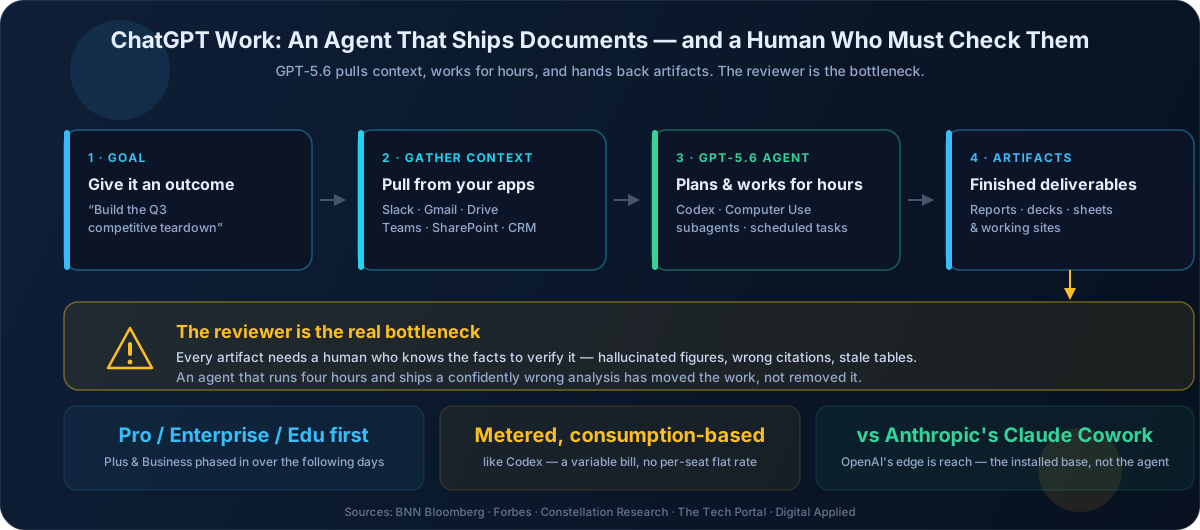
What Actually Shipped
ChatGPT Work is a workplace agent, not a chatbot mode. You give it a goal (“build the Q3 competitive teardown,” “run the month-end variance analysis,” “draft the launch site”) and it plans the steps, gathers what it needs, and produces the deliverable. The connected-apps list varies by outlet but consistently includes Slack, Gmail, Google Drive, Microsoft Teams, SharePoint, and CRM platforms (HubSpot is named), plus enterprise files and internal knowledge bases. You pull context by @-mentioning an app in the prompt. One outlet cites a unified directory of 1,400-plus plugins, though OpenAI did not confirm a single official integration list in this launch.
Underneath is GPT-5.6, which reached general availability across ChatGPT, ChatGPT Work, Codex, and the API on the same day. It had been in a limited API and Codex preview since late June. The model ships as a three-tier family: Sol (the flagship, deepest reasoning), Terra (the balanced everyday workhorse), and Luna (the fast, cheap option for high-volume work). We covered the model’s general-availability rollout and the Sol/Terra/Luna split separately; the short version is that ChatGPT Work inherits a materially cheaper and more token-efficient engine than the one it replaces.
The feature list beyond the core loop is where OpenAI’s accumulated agent work shows up: Codex is embedded directly, scheduled tasks let a job continue on its own timetable, a “Sites” feature builds shareable interactive dashboards, and an “Ultra mode” deploys teams of agents against one problem. On desktop, “Computer Use” gives the agent local file access, a built-in multi-tab browser, and the ability to click, type, and move files. The macOS app ships to all plans at launch, with Windows following.
Pricing is the conspicuous gap. ChatGPT Work is metered on consumption, like Codex, rather than sold as a flat per-seat add-on, and OpenAI published no per-task rates at launch. The only confirmed numbers are GPT-5.6 API token prices, and even those come from trackers and analysts rather than a fetched OpenAI pricing page:
| GPT-5.6 tier | Input / 1M tokens | Output / 1M tokens | Cached read / 1M |
|---|---|---|---|
| Sol (flagship) | $5.00 | $30.00 | $0.50 |
| Terra (balanced) | $2.50 | $15.00 | $0.25 |
| Luna (fast/cheap) | $1.00 | $6.00 | $0.10 |
Sam Altman framed the launch around cost scrutiny — “every enterprise now is thinking about spend and the value they’re getting in exchange for AI” — and claimed GPT-5.6 is “54% more token efficient on agentic coding.” A separate, often-conflated claim from pricing trackers holds that Terra matches GPT-5.5 performance at roughly half the cost. These measure different things and should not be stacked into one number.
How It Compares to Claude Cowork
OpenAI is not entering an empty market. Anthropic’s Claude Cowork shipped months earlier with the same core promise: point it at an outcome and it plans and executes multi-step work autonomously. Cowork runs through Claude’s desktop app directly against your local file system: you aim it at a folder, describe what you want, and it chains skills across Slack, Gmail, Notion, and CRMs through a plugin architecture with persistent context. We looked at how far that goes when Anthropic added remote control and its Dispatch feature to Cowork, which lets you hand off work from a phone and collect the result later.
The architectural gap between the two products just narrowed. Historically, ChatGPT’s agent lived on the web behind a virtual browser — strong for scraping, research, and booking, weaker at the persistent context, file-system access, and plugin chaining that made Cowork feel like a coworker rather than a research assistant. ChatGPT Work’s desktop Computer Use and its large plugin directory close much of that distance. What OpenAI brings that Anthropic cannot match is reach: hundreds of millions of existing ChatGPT accounts and, per OpenAI’s own figures, more than five million weekly Codex users, over a million of them working outside software development. That installed base is the real weapon here, not the model.
Microsoft (Copilot and its “Copilot Cowork” push), Google, and Salesforce are all cited as competing in the same autonomous-workplace-agent category. The framing across coverage is consistent: this is a land grab, and OpenAI moved because the gap with Cowork had become a competitive liability.
Does “Works Autonomously for Hours” Hold Up
This is the claim to interrogate, because it is doing most of the marketing work. “Stays with complex projects for hours” is a capability assertion, not a measured benchmark. OpenAI did not specify a maximum duration for ChatGPT Work, and there is no independent verification of sustained multi-hour reliability at launch. The nearest reference point is OpenAI’s own Codex lineage, which headlined seven-plus-hour independent sessions, but a coding agent grinding on a well-scoped repository is a very different problem from an agent synthesizing a board deck out of Slack threads and CRM records.
Duration is the wrong metric anyway. An agent that runs for four hours and produces a confidently wrong revenue analysis has not saved anyone time; it has moved the work from “do the analysis” to “audit the analysis,” which for a finance lead is often the more expensive half. The failure modes that matter for a document-shipping agent are the ones no runtime figure addresses: hallucinated figures in a spreadsheet, a citation pointing to a source that does not say what the summary claims, a deck built on a stale pricing table. Every generated artifact still needs a human who knows the underlying facts to verify it, and that reviewer is the actual bottleneck.
Then there is data access. An agent with read permissions spanning Slack, Gmail, Drive, and the CRM is a governance surface, not just a productivity feature. OpenAI has clearly built for this: Plan mode requires step-by-step approval before the agent acts, there are configurable check-ins and action approvals, and admins get spend controls and governance policies through the Admin Console. Those are the right controls, but they sit in direct tension with the “works for hours on its own” pitch — the more you supervise, the less autonomous it is, and the autonomy is what was being sold.
Read the early-customer numbers in that light. Zapier crediting lead-triage QC with “seven figures in pipeline every month,” Virgin Atlantic compressing competitor analysis from weeks to hours, a red-team result of “100% of data-extraction attempts blocked” — all trace to a single secondary source and are self-reported or red-teaming-only. Treat them as directional signals of where the tool helps, not as verified performance.
What To Watch
The consumption-based pricing is the first thing that will separate real adoption from pilots. Metering an agent that can run for hours across dozens of tool calls makes cost genuinely hard to forecast: a single ambitious project could burn far more than a per-seat license would have. Enterprises that adopted flat-rate Copilot or ChatGPT Team seats know what a month costs; ChatGPT Work asks them to accept a variable bill for variable-quality output. Altman’s spend-scrutiny framing reads, in that light, less like confidence and more like getting ahead of the invoice conversation.
The second is where the packaging war goes for smaller buyers. OpenAI aims ChatGPT Work at the enterprise, but the same logic (sell the outcome, not the model) is what Anthropic used to reach down-market with Claude for Small Business and its pre-built workflows. ChatGPT Work has no equivalent packaged-workflow layer for a ten-person company; it hands you a general agent and expects you to point it. For a firm without someone to design and supervise the agent’s tasks, that generality is a cost, not a feature.
For teams evaluating this, the recommendation is the unglamorous one. Pick a single, non-critical workflow where the output is easy to verify (a recurring report, a first-draft deck), run ChatGPT Work against it for a few weeks, and measure the metered cost against the time your reviewer actually spends checking the result. The autonomy claim will be true or false on your own processes long before any benchmark settles it, and the reviewer’s hours are the number that decides whether this is leverage or just faster work to double-check.
Sources
- OpenAI launches ChatGPT Work — BNN Bloomberg
- OpenAI Debuts ChatGPT Work, Workplace AI Agent With GPT-5.6 — Forbes
- OpenAI launches ChatGPT Work, rolls out GPT-5.6 model family — Constellation Research
- OpenAI launches GPT-5.6-powered ChatGPT Work — The Tech Portal
- ChatGPT Work: OpenAI Agent Launch 2026 — Digital Applied