
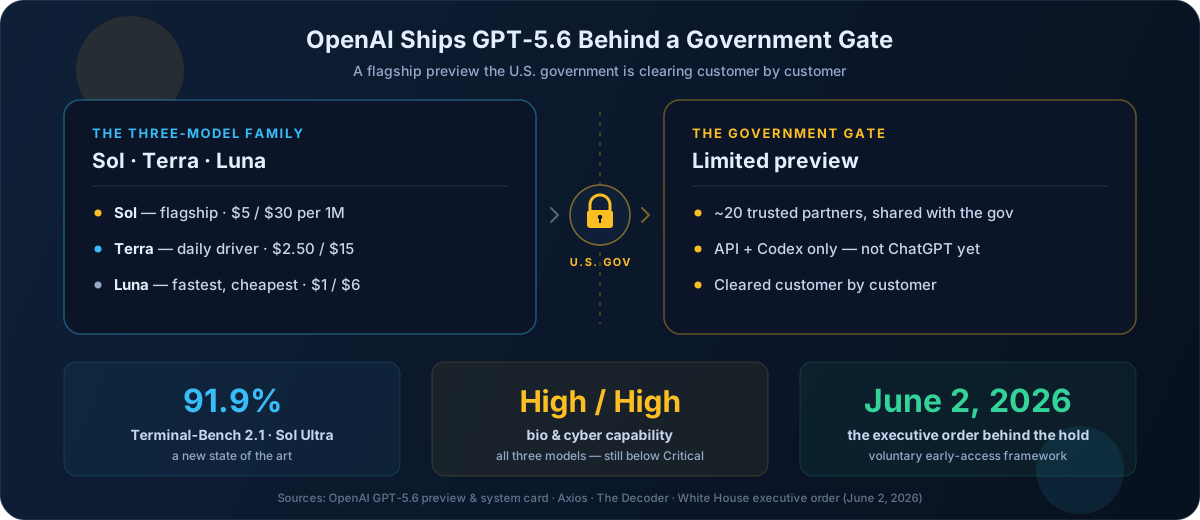
OpenAI previewed GPT-5.6 today — a three-model family it calls Sol, Terra, and Luna — and the model is the smaller half of the story. The larger half is that OpenAI didn’t actually release it. At the U.S. government’s request, the company is starting with a limited preview for roughly 20 trusted partners, reachable only through the API and Codex, with the government approving access customer by customer. Everyone else gets a blog post and a promise of broad availability “in the coming weeks.”
For eighteen months the gating playbook was reserved for narrow, obviously dangerous specialists — a cyber-permissive variant here, a life-sciences model there. GPT-5.6 Sol is the first time a lab has put its flagship general-purpose model behind that gate, and the first time the gatekeeper is the federal government rather than the lab’s own risk team. That is the precedent worth paying attention to, more than any benchmark on the chart.
What OpenAI actually announced
GPT-5.6 introduces a naming change OpenAI has been telegraphing for a while. The number is now the generation; the names are durable tiers. In the company’s words, “the number identifies a model’s generation, while Sol, Terra, and Luna identify durable capability tiers that can advance on their own cadence.” Sol is the flagship — built for complex reasoning, long coding sessions, and agentic work. Terra is the daily driver, pitched as competitive with GPT-5.5 at half the price. Luna is the cheap, fast tier. The internal-codename era — GPT-5.5 shipped as “Spud” — is over; the tier name is now the product.
Two new controls ship with Sol. A max reasoning effort gives the model “the most time to reason deeply,” and a new ultra mode “goes beyond the capabilities of a single agent by leveraging subagents to accelerate complex work.” Ultra is OpenAI’s answer to the orchestration pattern Anthropic productized in Opus 4.8’s dynamic workflows — a model that spins up its own helpers instead of running as one agent. It is also the configuration behind Sol’s headline benchmark number.
Pricing is published as API list rates, per million tokens:
| Tier | Role | Input | Output |
|---|---|---|---|
| Sol | Flagship | $5.00 | $30.00 |
| Terra | Daily driver | $2.50 | $15.00 |
| Luna | Budget / fastest | $1.00 | $6.00 |
Sol lands at exactly GPT-5.5’s $5/$30 — OpenAI held flagship pricing flat across the generation, and undercut Anthropic’s Claude Fable 5 ($10/$50) by roughly half. Terra at $2.50/$15 is the genuinely interesting line: half of GPT-5.5’s standard rate for performance OpenAI says is competitive with it. The catch is that none of these are buyable yet. At launch the preview runs through the API and Codex only — not ChatGPT Plus, Pro, Team, or Enterprise — and only for the approved shortlist.
The benchmark case is also the problem
On raw capability, Sol clears the bar OpenAI set in April. With Ultra mode and its subagents engaged, Sol posts a state-of-the-art 91.9% on Terminal-Bench 2.1, the agentic command-line benchmark. Even without Ultra, the best single-agent Sol run lands around 88.8%, still ahead of both Anthropic frontier models on the same test.
| Model (Terminal-Bench 2.1) | Score |
|---|---|
| GPT-5.6 Sol — Ultra (subagents) | 91.9% |
| GPT-5.6 Sol — single agent | ~88.8% |
| Claude Mythos 5 | 88.0% |
| Claude Fable 5 | 84.3% |
| GPT-5.5 | 83.4% |
The gains OpenAI chose to foreground are not the usual coding-and-math leaderboard. They are cyber and biology. On OpenAI’s cyber evaluation, Sol matches the offensive-security capability of Anthropic’s Claude Mythos preview while using roughly a third of the output tokens. On a genomics benchmark it beats GPT-5.5, again more efficiently. The system card rates all three models High in both biological/chemical and cybersecurity capability under OpenAI’s Preparedness Framework — the first time even the smaller, cheaper members of a family have earned a High designation in a tracked risk category — while stopping short of the “Critical” threshold.
That capability is the headline and the reason for the gate at the same time, and OpenAI’s own document draws the line plainly: Sol and Terra “can find vulnerabilities and pieces of exploits, but were unable to carry out autonomous, end-to-end attacks against hardened targets.” This is the same boundary the labs have been narrating all year — genuine offensive-security uplift at machine speed and cost, still short of an autonomous zero-day machine. We traced exactly that frontier in OpenAI’s GPT-5.5-Cyber and Codex Security release last week. With GPT-5.6, that capability is no longer confined to a vetted cyber program. It is baked into the flagship — which is precisely what made the rollout a government question.
The government gate
Here is what is new. OpenAI says the limited preview is happening “at the U.S. government’s request.” Reporting from Axios and The Information fills in the mechanism: the ask came from two White House offices — the Office of Science and Technology Policy and the Office of the National Cyber Director — and during the preview the government is signing off on partners customer by customer. Commerce Secretary Howard Lutnick reportedly warned Sam Altman directly, two days before launch, not to proceed without sign-off from additional agencies.
The legal scaffolding is an executive order President Trump signed on June 2, 2026, “Promoting Advanced Artificial Intelligence Innovation and Security.” It sets up a voluntary framework for developers to give the government early access to “covered frontier models” for up to 30 days before release, with a classified, NSA-run process deciding which models are “covered.” Crucially, the order’s own text disclaims the obvious reading: nothing in it, Section 3(c) says, authorizes “a mandatory governmental licensing, preclearance, or permitting requirement” for releasing a model.
Multiple outlets nonetheless framed GPT-5.6 as the first time the U.S. government has preemptively asked an American AI company to restrict a model’s launch before it shipped. Altman, for his part, made clear OpenAI is not happy about the arrangement: the company has told the government “this is not our preferred long term model, and will work with them and others in industry to achieve a more sustainable approach for future releases."
"Voluntary” is doing a lot of work
The gap between the executive order’s text and what actually happened this week is the part worth sitting with. The order says no licensing regime. In practice, a model cannot reach a customer until a federal office approves that specific customer — which is what a license is, whatever the paperwork calls it. And this is the second time in a month the pattern has played out. On June 12, a Commerce Department export-control directive forced Anthropic to disable its Fable 5 and Mythos 5 models for all customers, days after launch. One lab had a model taken offline after release; the other had its flagship held back before release. Both complied.
The critics are not only the usual deregulation voices, though they are loudest. The AI-policy outlet Transformer News called the episode “the clearest sign yet that the US now has a licensing regime for frontier AI models.” Analysts at the R Street Institute and the Abundance Institute warned against a system where “the US government should not hang a Sword of Damocles over every lab’s head, with no indication when it might drop or why.” The structural objection underneath the rhetoric is real: customer-by-customer approval, run through a classified process, with no published criteria and no clear appeal, turns frontier access into a function of government relationships. The ~20 partners on the current list have not been disclosed, which means nobody outside the room can yet say whether access is tracking risk or tracking proximity.
This is the gating pattern we’ve been documenting all year, escalated one decisive step. Through the spring, labs gated their most dangerous specialists — Claude Mythos and Project Glasswing, the cyber and life-sciences variants — and made the case that the frontier was splitting into gated specialists and open generalists. GPT-5.6 Sol breaks that tidy split. The gated model is now the generalist flagship, and the entity holding the key is the state.
What it means if you’re not one of the 20
For almost every business, the practical answer this week is: nothing changes yet. You cannot deploy Sol, Terra, or Luna, because you almost certainly are not on the list. The model you actually run in production is still GPT-5.5, and it remains a capable, fully available option. When the preview opens, Terra is the tier to evaluate first — competitive-with-5.5 performance at half the token cost is the kind of price move that resets unit economics for high-volume workloads, and it slots straight into the crowded coding-agent market where margin is the whole game.
But treating this as just another model drop misses what happened. The durable change is not Sol’s Terminal-Bench score; it is that a frontier lab’s general-purpose flagship now reaches the market on a schedule the federal government controls, justified by a capability the lab’s own system card says falls short of catastrophic. If customer-by-customer approval becomes the default rather than a one-off, the question for anyone planning around frontier AI stops being “which model is best” and becomes “who decides whether I can use it.” That decision moved this week, quietly, and neither OpenAI nor the White House has said when it moves back.
Sources
- Previewing GPT-5.6 Sol — OpenAI
- GPT-5.6 Preview System Card — OpenAI Deployment Safety Hub
- OpenAI upgrading ChatGPT and Codex with new GPT-5.6 models in limited release — 9to5Mac
- OpenAI unveils GPT-5.6 Sol, Terra and Luna — VentureBeat
- Trump administration asks OpenAI to limit release of GPT-5.6 — Axios
- OpenAI’s GPT-5.6 rollout now requires US government approval, customer by customer — The Decoder
- Promoting Advanced Artificial Intelligence Innovation and Security — The White House
- Executive order sets voluntary cyber reviews for advanced AI — Roll Call