
OpenAI launched GPT-Live-1 and GPT-Live-1 mini on July 8, its third generation of ChatGPT voice technology and the replacement for Advanced Voice Mode. The headline feature is that the models are full-duplex: they process what you say and generate what they say at the same time, rather than waiting for you to stop talking before they start. It rolled out globally the same day across iOS, Android, and web, with GPT-Live-1 as the default for paid users and the mini as the default for free ones.
The more useful read is architectural. Full-duplex timing is the visible change, but the interesting design decision is underneath it: GPT-Live is a fast conversational model that hands off to a separate frontier text model, GPT-5.5 at launch, whenever a query actually needs to search the web, reason deeply, or take agentic steps. The voice layer stays live while the heavy model works in the background. That split is what makes the demos feel fluid, and it is also the tell for where this generation still leans on something bigger than itself.
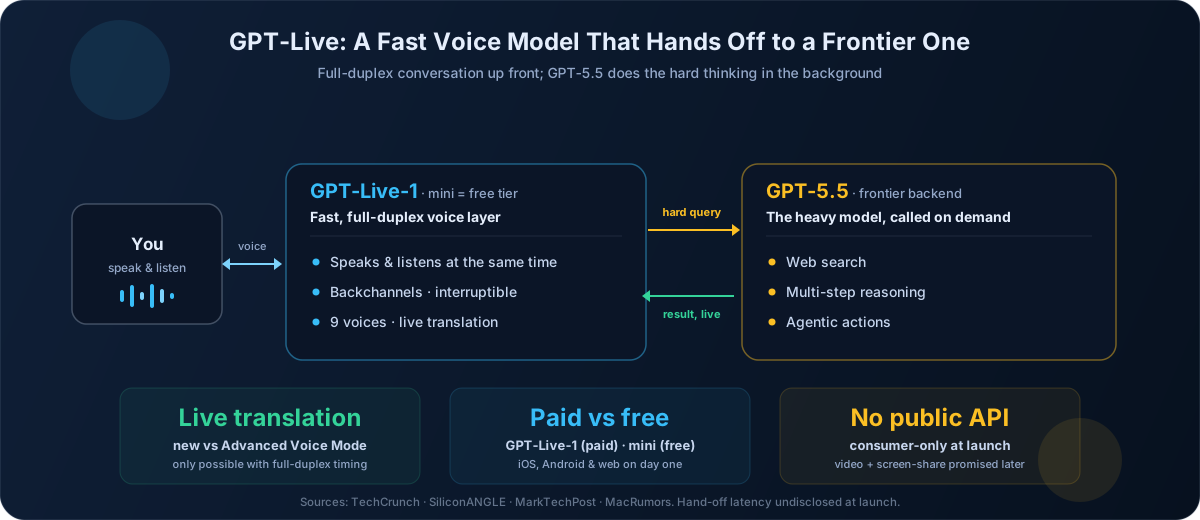
What Actually Shipped
Two models, not one. GPT-Live-1 is the default for paid tiers (Go, Plus, and Pro per MacRumors’ breakdown), and GPT-Live-1 mini is the default for free users, where it replaces Advanced Voice Mode outright. Coverage is slightly inconsistent on the exact tier mapping: TechCrunch frames it as “mini for free users, the larger model for paid,” while MacRumors gives the more specific Go/Plus/Pro split. Either way, the free experience is now the mini, and the paid experience is the full model.
The full-duplex behavior is the substance. Instead of the old half-duplex, turn-based exchange (you talk, it waits, it responds), the model makes interaction decisions many times per second: whether to speak, listen, pause, interrupt, or invoke a tool. In practice that means it can drop in backchannels like “mhmm,” “yeah,” and “got it” while you are still talking, and you can interrupt it, pause to gather your thoughts, or ask it to slow down mid-response without breaking the exchange. OpenAI’s framing, via MacRumors: “Talking with ChatGPT should now feel much more like a real conversation.”
The genuinely new capability versus the old voice mode is real-time live translation, which the previous version could not do and which is only possible because of the full-duplex timing. Alongside it, GPT-Live ships nine remastered voices, three reasoning levels (Instant, Medium, High), and rich visual cards for weather, stocks, and sports. It supports search, memory, image input, and file uploads.
What it does not do yet: voice with video, or screen sharing. OpenAI says both are coming. There is also no public API for GPT-Live at launch — a notable omission for a company whose developer platform is usually the point, and one that keeps this firmly a consumer release for now.
The Hand-Off Is the Real Story
Strip away the marketing and GPT-Live is a two-model system. The conversational model is optimized for latency and natural turn-taking; it is not the thing that answers a hard question. When a query needs web search, multi-step reasoning, or an agentic action, GPT-Live delegates to a background frontier model — GPT-5.5, described by OpenAI as its most advanced commercially available model — and returns the result mid-conversation without pausing the voice interaction. SiliconAngle’s characterization is accurate: during conversations, the model “regularly checks whether it should interrupt the user, search the web or perform some other task.”
This is a sensible piece of engineering, and it resolves the two things that made Advanced Voice Mode frustrating: it interrupted users while they were still speaking, and it was not smart enough to answer harder questions in voice. Splitting the job lets the fast model own the conversation and the slow model own the thinking. It is the same architectural instinct behind routing systems in agentic products — keep a cheap, responsive layer in front and escalate to an expensive model only when the task demands it. If you have followed the industry’s move toward more capable agentic frontier models like Claude Sonnet 5, the pattern is familiar: the frontier model is increasingly a backend resource that other systems call, not the surface the user touches directly.
The dependency cuts both ways, though. GPT-Live’s ceiling for anything substantive is GPT-5.5’s ceiling, plus whatever latency the hand-off introduces. OpenAI has not disclosed how long that round trip takes, and latency is exactly the number that determines whether “returns the result mid-conversation” feels seamless or feels like the model trailing off and coming back. No published latency figure, no consumer pricing beyond tier gating: two gaps to weigh before taking a launch demo’s fluidity at face value.
How It Compares
The clearest comparison is to OpenAI’s own recent work. On May 7, the company shipped a set of developer-facing audio models in the Realtime API: GPT-Realtime-2 (GPT-5-class reasoning voice), GPT-Realtime-Translate (live translation), and GPT-Realtime-Whisper (streaming speech-to-text). GPT-Live is the consumer-facing successor to that direction — the same full-duplex-plus-translation bet, packaged into ChatGPT rather than sold as API primitives.
The pricing on those May models is worth keeping in view, because it is the only hard cost signal OpenAI has published in this area and it is not cheap:
| Model (May 7, 2026) | Function | Price |
|---|---|---|
| GPT-Realtime-2 | Reasoning voice | $32 / 1M audio input tokens; $64 / 1M audio output |
| GPT-Realtime-Translate | Live translation, 70+ langs to 13 | $0.034 / minute |
| GPT-Realtime-Whisper | Streaming speech-to-text | $0.017 / minute |
Voice-token pricing at $64 per million output tokens is an order of magnitude above text, which is part of why GPT-Live’s consumer economics, still undisclosed, matter. Running a genuinely conversational, always-listening model for 150-million-plus ChatGPT voice users is not a rounding error, and the tier split (mini for free, full model for paid) is the most visible lever OpenAI has to manage that.
On the competitive side, OpenAI is not alone. Apple, Amazon, and the startup Sesame are all building conversational voice systems, and voice cloning has become table stakes elsewhere — xAI shipped custom voices and cloning in Grok 4.3 back in May. GPT-Live’s differentiator is not the voices; it is the full-duplex timing and the frontier hand-off, which is a harder system to build than a bank of expressive TTS voices. Coverage also floated competitor model references: a “Claude Mythos 5” cited around GPT-5.6 performance, and a commenter favorably naming Claude’s Opus voice model. Neither is a verified head-to-head voice benchmark, and neither should be read as one.
The Numbers, and What They Aren’t
OpenAI says GPT-Live-1 and GPT-Live-1 mini were “strongly preferred over Advanced Voice Mode” in head-to-head human evaluations across overall preference, turn-taking, interruptions, flow, and naturalness, and it reported automated-benchmark gains on GPQA (expert science reasoning), BrowseComp (agentic web search), and a τ³-Voice Telecom multi-turn support benchmark. Product lead Atty Eleti described holding 30-to-40-minute continuous conversations while walking.
Every one of those results is OpenAI’s own internal evaluation. None is independently verified, and the preference tests are graded against the product’s own predecessor, which is the easiest possible baseline to beat. A “pleasantness” score of 75.5 circulated in one outlet’s coverage (SiliconAngle) but appears nowhere else and reads like a garbled rendering of the preference charts — treat it as noise.
The unglamorous signal is the early user feedback, which is where a voice product actually gets judged. Testers flagged GPT-Live as “over-enthusiastic,” with the “mhmm” backchannels, the exact feature meant to make it feel human, described as distracting. A live-translation demo showed accent inconsistencies in Hindi. Those are not fatal, but they are the kind of thing that internal preference evals do not catch and daily use does. The backchannel that reads as warm in a two-minute demo reads as needy over a thirty-minute walk.
What To Watch
Three things will decide whether this is a step change or an incremental voice refresh. First, latency on the hand-off: an undisclosed number that determines whether escalating to GPT-5.5 feels invisible or intrusive. Second, whether an API arrives — without one, GPT-Live stays a consumer feature and the developer story remains the May Realtime models, which is a meaningfully smaller ambition than OpenAI usually signals. Third, whether OpenAI dials back the enthusiasm; the over-eager persona is a tuning problem, and how fast they fix it will say something about how seriously they take the “not an AI companion” positioning they explicitly claimed at launch, complete with age-appropriate safeguards and self-harm resources.
GPT-Live solves the two concrete complaints about Advanced Voice Mode, interruption and intelligence, with a clean architectural split, and it does so at genuine scale on day one. The frontier model does the thinking; the fast model does the talking. That works. Whether it feels like a real conversation, rather than a well-engineered impression of one, is the part no benchmark OpenAI has released can answer, and the part the next few weeks of actual use will.
Sources
- OpenAI releases new voice models for more natural live conversations — TechCrunch
- OpenAI launches GPT-Live voice model series — SiliconAngle
- OpenAI Releases GPT-Live and GPT-Live-1 mini — MarkTechPost
- OpenAI Introduces GPT-Live — MacRumors
- OpenAI’s new voice models that reason, translate, and transcribe as you speak — 9to5Mac