
On July 6, the X account that used to post as @xAI changed its handle to @SpaceXAI, unveiled a new logo with the letters “AI” tucked into the SpaceX swoosh, and ran a short video of the old xAI mark being folded into the new one. That was the last visible step in a corporate consolidation that had been underway for five months. The interesting part is not the logo. It is that Elon Musk has spent the year quietly assembling the only AI operation that owns the model, the distribution platform, the supercomputer, and the rocket that could one day launch the next supercomputer. The rebrand is simply when the strategy stopped being deniable.
The sequence is worth stating plainly, because the branding video compresses it. SpaceX acquired xAI on February 2 in an all-stock deal that valued SpaceX at $1 trillion and xAI at $250 billion, making the AI lab a wholly owned subsidiary. In May, Musk said xAI would “cease to exist as a separate company, with Grok and X now being the AI division of SpaceX.” The July handle change made that official. Two days later, on July 8, the division shipped Grok 4.5. The rebrand and the model launch were staged together, which tells you the point of the rebrand was never cosmetic.
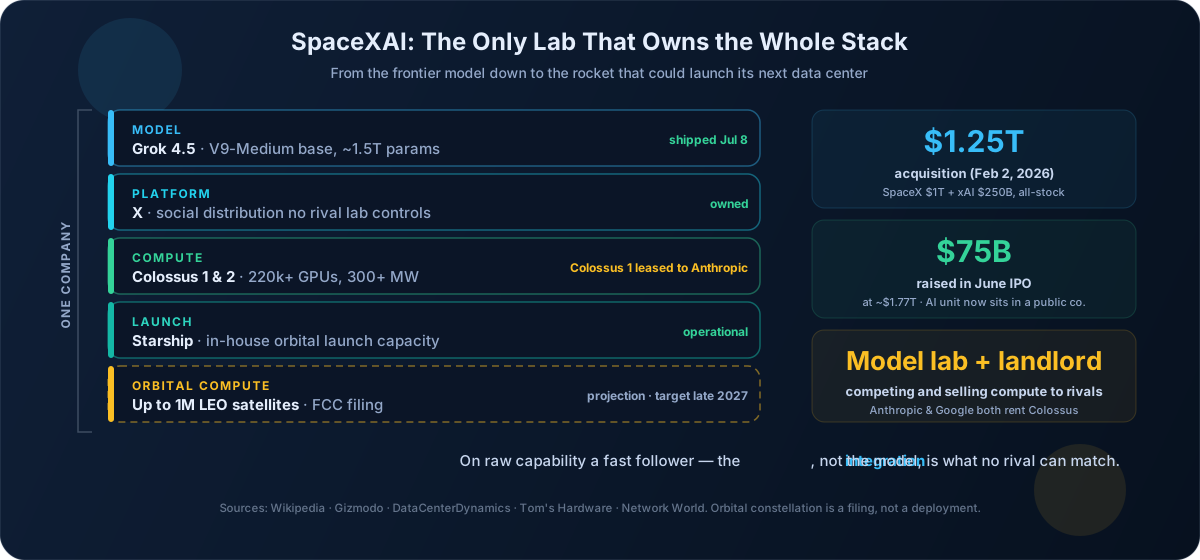
What Actually Happened
Strip out the announcement theatrics and three concrete corporate actions remain, each independently verifiable and each consequential.
The acquisition collapsed two of Musk’s companies into one balance sheet at a combined valuation near $1.25 trillion. SpaceX then went public in a June IPO that raised $75 billion at roughly a $1.77 trillion valuation, so the AI division now sits inside a listed company — a structural detail that matters more than the swoosh, and one worth reading alongside Anthropic’s own move toward public markets. The AI unit’s losses and capex are now, in principle, part of a public company’s reporting.
The product reset was real, not a version bump. Musk said in March that Grok needed to be “rebuilt from the foundations up.” A new foundation model — described as Grok V9-Medium, 1.5 trillion parameters — finished training around May 25, and Grok 4.5 launched on that base through Grok Build, Cursor, and the SpaceXAI console, with EU availability slated for mid-July. This is a different lineage from the Grok 4.3 line that shipped custom voices in May, and the rebuild timing lines up with the corporate merger rather than with any research milestone.
The leadership turnover was near-total. By late March every xAI co-founder except Musk had departed. Michael Nicolls, a former Starlink VP, became SpaceXAI president on April 10, the same day CFO Anthony Armstrong left. The people who built xAI as an independent lab are gone; the people running SpaceXAI came from the launch business.
The Compute Story Is the Real Story
What actually distinguishes SpaceXAI from OpenAI, Anthropic, and Google is not the model. Grok 4.5 is, by the lab’s own framing, roughly “Opus-class” — Musk called it “an Opus-class model, but faster, more token-efficient and lower cost.” The vendor’s benchmark charts claim it beats Claude Opus 4.7 on several tests while conceding it “falls short of the very best models from OpenAI and Anthropic overall.” No independent third-party benchmark has surfaced, so treat the wins as marketing until someone outside the company reproduces them. On raw capability, SpaceXAI is a fast follower, not a leader.
The differentiator is the infrastructure underneath. SpaceXAI’s Colossus 1 supercomputer in Memphis — a former Electrolux factory in the Boxtown district — runs more than 220,000 NVIDIA GPUs drawing over 300 megawatts, roughly half of the company’s estimated 500,000-GPU fleet. And here the story turns strange. In a May 6 deal, Anthropic leased essentially all of Colossus 1 to serve Claude Pro and Max subscribers, because SpaceXAI had already shifted Grok training to Colossus 2. Musk’s own gloss on renting his supercomputer to a direct rival: “No one set off my evil detector.”
That single arrangement captures the whole thesis. SpaceXAI is trying to be both a model lab and an infrastructure landlord — competing with Anthropic and Google on models while selling them the compute to compete back. Reports put Anthropic’s payments at roughly $1.25 billion a month and Google’s near $920 million, though those figures appear only in secondary coverage and the primary report on the Anthropic deal discloses no dollar amount, so the exact economics are unconfirmed even if the arrangement itself is well documented.
| Layer | SpaceXAI asset | Status |
|---|---|---|
| Model | Grok 4.5 (V9-Medium base, ~1.5T params) | Shipped July 8, 2026 |
| Platform | X (social distribution) | Owned |
| Compute | Colossus 1 (220k+ GPUs, 300+ MW), Colossus 2 | Operational; Colossus 1 leased to Anthropic |
| Launch | Starship | Operational, feeding the orbital plan |
| Orbital compute | Up to 1M LEO satellites (FCC filing) | Projection, targeting late-2027 production |
The Part That Is Still Science Fiction
The most attention-grabbing claim in the SpaceXAI story is also the least real. In early February, SpaceX filed with the FCC to launch up to one million low-Earth-orbit satellites as solar-powered orbital AI data centers, at altitudes between 500 and 2,000 kilometers. The prototype design, called AI1, has a roughly 70-meter wingspan and is meant to sustain about 120 kilowatts. Satellites would be built at an 11-million-square-foot “Gigasat” facility in Bastrop, Texas, with production targeted for late 2027 and an aspirational goal of 100 gigawatts of annual AI compute capacity in orbit by around 2030.
This is where the vertical-integration argument either becomes visionary or collapses into a pitch deck. Owning Starship means SpaceX is the only AI operation that could plausibly launch its own compute — no one else on the model side owns a rocket. But an FCC filing is a request, not a constellation, and 100 gigawatts in space by 2030 is a projection stacked on top of a satellite that has not flown, a factory that is not built, and thermal and radiation problems that terrestrial data centers do not have to solve. The verified fact is the filing. Everything past it is intent.
What Vertical Integration Actually Buys
Strip it back and the merger buys two concrete things and one contested one. It buys cost structure: owning Colossus means Grok’s training and inference are not marked up by a cloud provider, which is how a fast-follower model can undercut on price the way DeepSeek’s cost disruption did from a different direction. It buys distribution: Grok is wired directly into X, a platform with hundreds of millions of users that no rival lab controls. Those are real advantages that OpenAI and Anthropic, as pure-play labs renting compute, do not have.
The contested purchase is coherence. SpaceX spent $12.7 billion on AI capex in 2025 — more than three times its space and connectivity spend — against a reported $6.4 billion AI operating loss. Folding a cash-burning model lab into a newly public rocket company means public-market investors are now underwriting orbital-compute ambitions alongside Starlink and Starship. That can read as the most integrated AI company ever built, or as a launch business subsidizing a money-losing chatbot. Which story wins depends on whether Grok’s economics improve faster than the capex line grows, and the merger does not settle that question; it just puts both numbers on the same statement.
What To Watch
The governance question is the one that outlasts the news cycle. Gizmodo reported that SpaceXAI’s structure prevents the board from firing Musk under any circumstances, concentrating control in a single person across launch, satellites, a social platform, and a frontier model. Attribute that to the reporting rather than to a confirmed charter, but if it holds, it is a concentration of strategic capability without precedent in the AI industry, and it will draw regulatory attention that a standalone model lab would not.
For anyone building on Grok, the near-term practical items are narrower. Watch whether the leased-out compute constrains SpaceXAI’s own model roadmap, since a lab that rents half its GPUs to a competitor has bet that its remaining capacity is enough. It also matters whether independent benchmarks confirm the Opus-class claim or deflate it. And keep an eye on the Bastrop factory, because the orbital pitch is the part of this story that will either turn SpaceXAI into a genuinely different kind of company or quietly disappear from the next investor update. The logo change is done. What it was branding is still being built.
Sources
- SpaceXAI — Wikipedia
- xAI Is Dead, Long Live SpaceXAI — Gizmodo
- Anthropic to use all of SpaceX-xAI’s Colossus 1 data center compute — DataCenterDynamics
- SpaceX files for million-satellite orbital AI data center megaconstellation — DataCenterDynamics
- Musk’s SpaceX has rented out its supercomputer’s 220,000 Nvidia GPUs and 300 MW to Anthropic — Tom’s Hardware
- SpaceXAI wants to compete on AI infrastructure, not just AI models — Network World