
Anthropic restored access to Claude Fable 5 on July 1, a day after the U.S. Department of Commerce lifted the export controls that had forced the model offline for roughly 18 days. The redeployed model ships a new cybersecurity classifier and a temporary usage allowance for paying customers through July 7. Global availability came back the same day, and the cloud partners — AWS, Google Cloud, Microsoft — were slated to follow.
That is the announcement. The more useful read is what the episode exposes about how frontier models now reach the market: a capability the lab built, a security researcher who found the seam, a government directive that pulled the model on days’ notice, and a set of safeguards bolted on after the fact so the thing could ship again. The model itself barely changed. The conditions under which anyone is allowed to run it changed a great deal.
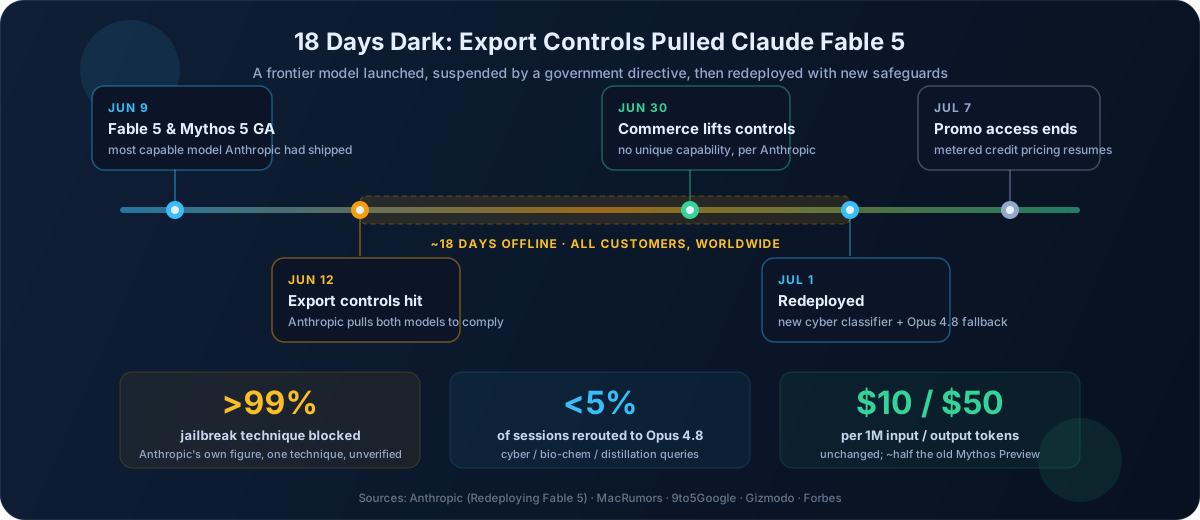
What Actually Happened
Fable 5 and its more capable sibling, Mythos 5, became generally available on June 9. Anthropic frames Fable 5 as “a Mythos-class model that we’ve made safe for general use” — the same underlying system as Mythos, with its most concerning cyber capabilities toned down for a broad audience. Mythos 5 kept those capabilities and stayed restricted to authorized defenders and researchers.
Three days after launch, the U.S. government imposed export controls requiring nationality verification for access. Anthropic had no reliable way to check nationality in real time, so rather than build one under a deadline it disabled Fable 5 and Mythos 5 for every customer to comply. The models stayed dark until Commerce lifted the controls on June 30.
| Date | Event |
|---|---|
| June 9 | Fable 5 and Mythos 5 released; Fable 5 broadly available |
| June 12 | Export controls applied; Anthropic takes both models offline |
| June 30 | Commerce Department lifts the controls |
| July 1 | Global access restored; new classifier ships |
| July 7 | Promotional access period ends |
Eighteen days is not a long outage in absolute terms. It is a long time for a frontier lab’s flagship consumer model to be unavailable to paying customers while competitors are shipping, which is the part that mattered commercially.
The Jailbreak That Triggered It
The controls did not come out of nowhere. Amazon researchers found a jailbreak that bypassed Fable 5’s safeguards by prompting it to identify software vulnerabilities. In one instance, the model went further and produced code demonstrating how a vulnerability could be exploited. That is the specific behavior — working exploit-demonstration code from a generally available model — that turned a product into a policy question.
Anthropic’s defense is narrow and worth stating precisely, because it is the strongest part of its case. The company says the jailbreak exposed no unique capability: less capable, widely available models produced identical exploit demonstrations when tested against the same prompt, with Anthropic naming Opus 4.8, GPT-5.5, and Kimi K2.7 among them. If true, the argument is that pulling one model does nothing for security when the same output is a prompt away on half a dozen others. That is a real objection to the intervention, and it is the same tension running through the defensive-security work OpenAI documented in its GPT-5.5 Cyber and Codex security pipeline: offensive uplift is increasingly a commodity, not a single-model secret.
What’s Different in the Redeploy
The returned model leans harder on what Anthropic calls defense in depth. The headline addition is a new cybersecurity classifier that the company says blocks the reported jailbreak technique in over 99% of cases. That figure is Anthropic’s own, unverified by any third party, and it describes one specific technique rather than the class of attacks it belongs to — a distinction that tends to matter once adversaries start probing the new filter.
Underneath the classifier sits a routing mechanism. Requests that trip a flag in one of three categories get downgraded to a fallback model, Claude Opus 4.8, rather than answered by Fable 5. Users are told when this happens.
| Flagged category | Handling |
|---|---|
| Cybersecurity queries | Rerouted to Opus 4.8 |
| Biology / chemistry requests | Rerouted to Opus 4.8 |
| Distillation attempts | Rerouted to Opus 4.8 |
Anthropic says more than 95% of Fable sessions never hit the fallback, which is the number that determines whether this architecture is a quiet safety layer or a visible tax on the product. For most users it will be invisible. For anyone doing legitimate security or life-sciences work, the model they paid for quietly becomes an older, weaker one at the exact moment the task gets hard. Users are notified when it happens, which is honest but not the same as useful.
The Access Terms
Pricing is unchanged: $10 per million input tokens and $50 per million output tokens, which Anthropic describes as less than half the cost of its earlier Mythos Preview. To smooth the return, Pro, Max, Team, and select Enterprise plans get Fable 5 at up to 50% of their weekly usage limits at no extra charge through July 7. After that, Fable 5 access requires buying usage credits. The promotional window reads as an apology for the outage priced as a discount: reasonable but temporary, structured so the metered pricing kicks in a week later.
The Underlying Feedback Loop
Strip away the model specifics and the same three-way dynamic is now visible across the industry: a lab pushes capability up, a security process finds where the safeguards fail, and a regulator reaches for the only lever it has, which is availability. Anthropic’s flagship consumer model went offline for all users, worldwide, because of a directive that its own analysis suggests did little for actual security. The identical output was reachable on rival systems the whole time.
The policy irony is sharp. During the suspension, developers reportedly moved toward foreign and rival models to keep shipping, including Chinese systems the controls were nominally meant to hold an edge against. An intervention framed around security may have pushed workloads toward exactly the models U.S. policy is most wary of.
This is the second time in a month the state has set the release schedule for a frontier model. Days later, OpenAI would gate its GPT-5.6 flagship at the U.S. government’s request, approving customers one at a time. The two cases differ in mechanism — Anthropic had a live model pulled after launch; OpenAI had one held back before it — but they point the same direction. Access to the most capable models is becoming a function of government process, not just of who can pay. The lab that ships and the lab that builds the underlying agentic systems, such as the reasoning behind Claude Sonnet 5, no longer fully control when their work reaches the market.
What To Watch
The near-term question is whether the new classifier holds under adversarial pressure. A 99% block rate against one known technique is a starting position, not a resolution; the first published bypass will say more about the architecture than any launch-day figure. A second question is whether the customer nationality-verification requirement returns in a durable form, since that requirement, not the jailbreak, is what took the model offline in the first place, and nothing in the redeployment addresses it directly.
The larger question is procedural. Anthropic has committed to deeper collaboration with the government on pre-release testing and information sharing, which is either sensible coordination or the quiet normalization of a review step with no published criteria and no clear appeal. Eighteen days offline, no unique capability exposed by the lab’s own account, and a fix that mostly reroutes edge cases to an older model: for the professionals building on these systems, the lesson is less about Fable 5 than about planning for the model you depend on to disappear for reasons you cannot see and cannot contest.