
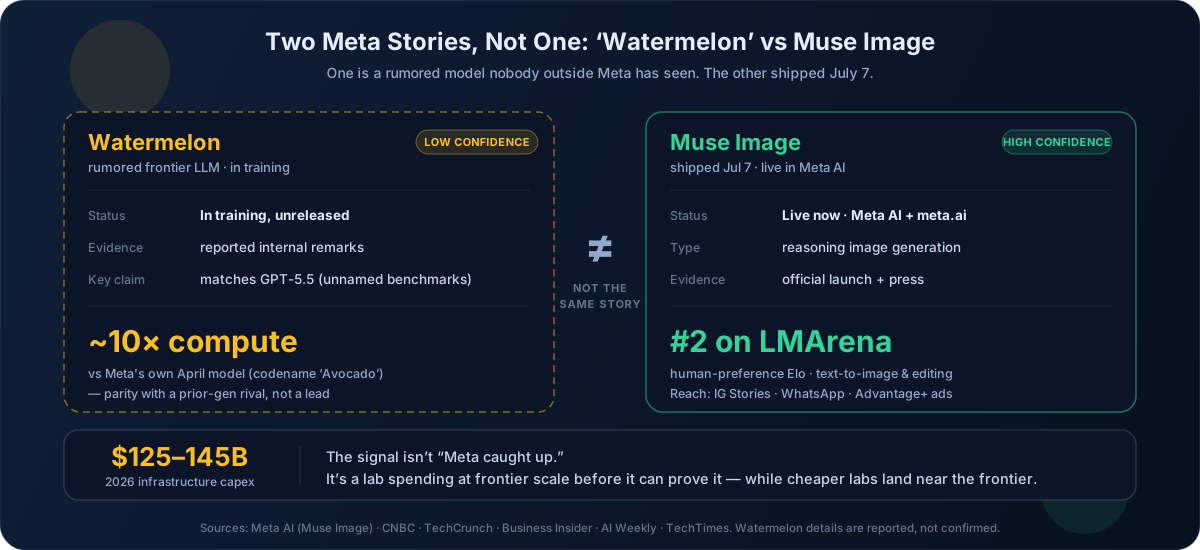
Two Meta AI stories landed within a week of each other, and the headlines have been busy blending them into one. They are not one. Muse Image shipped on July 7 — a real, public image-generation model from Meta Superintelligence Labs, live inside Meta AI. Watermelon is a rumor: an unreleased, still-training frontier LLM that Meta’s AI chief Alexandr Wang reportedly told employees around July 2 has “caught up with” OpenAI’s GPT-5.5 on internal benchmarks. One is a product you can use today. The other is a claim about a model nobody outside Meta has seen.
The more useful read separates the two and treats them accordingly. Muse Image is worth evaluating on its merits. Watermelon is worth reading not as a capability announcement, because it isn’t one, but as a signal about Meta’s compute posture and how much a lab will say out loud when it needs a win.
What Watermelon Actually Is (and Isn’t)
Start with what is confirmed: almost nothing. The reporting, first from Business Insider and then amplified across the AI trade press, is secondhand accounting of internal remarks. Meta declined to comment. OpenAI didn’t respond. There is no system card, no benchmark names, no scores, no release date. Watermelon is in training as of early July, and everything attributed to it is a paraphrase of what Wang reportedly said in a closed setting.
The one quantified claim is about compute, not capability. Watermelon reportedly uses “an order of magnitude more compute,” roughly 10x, than its predecessor Muse Spark, the April 2026 model carried internally under the codename Avocado. That number is the actual story, and it frames everything else.
The GPT-5.5 parity claim rests on unnamed, internally run evaluations. This is the least reliable class of evidence in the field: a lab grading its own unreleased model against a competitor’s, on benchmarks it won’t specify, relayed through a reporter. AI Weekly put it bluntly — unnamed internal benchmarks from the lab that most needs a win are “a leading indicator, not a datapoint.” Treat the parity claim as directional at best.
Why Matching GPT-5.5 Is the Wrong Milestone
Even granting the claim on its own terms, the target is a moving one that has already moved. GPT-5.5 is not OpenAI’s current frontier. OpenAI previewed GPT-5.6 in late June — the government-gated Sol preview we covered was already one generation past the model Watermelon reportedly matches. So the best-case reading is that a still-training Meta model has drawn level with a competitor’s previous release, at a point where the competitor has shipped its next one.
Now put that next to the 10x compute figure. Matching a prior-generation model while spending an order of magnitude more compute than your own last model is not a capability lead. It’s an efficiency deficit. The same cost-per-capability lens that made DeepSeek V4 a disruption story, a near-frontier open model at a fraction of the inference cost, cuts the other way here. DeepSeek’s pitch was more capability per dollar of compute. Watermelon’s reported profile is the same capability for roughly 10x the compute. In a market where the cost floor is being set by Chinese open-weight labs, that is the wrong direction to be scaling.
Meta’s capex makes the stakes concrete. The company now projects $125 billion to $145 billion in 2026 infrastructure spending, up from an earlier $115–135 billion range. Watermelon is what that money buys. A model that matches last quarter’s competitor at 10x your own prior compute is a hard thing to justify against that line item — which is likely why the parity framing exists at all.
The Context Meta Would Rather You Skip
The reporting carries a detail that undercuts the triumphant read. Mark Zuckerberg reportedly acknowledged that Meta’s AI agent work had not accelerated as expected over the prior four months. That gap between training frontier weights and shipping agents people actually use is the one that matters commercially. Anyone can report an internal benchmark. Turning a large model into a functioning consumer or enterprise agent is where Meta has, by its own leadership’s account, been slower than planned.
There’s also a data question the coverage flags but Meta hasn’t confirmed. Watermelon reportedly draws on proprietary data from Facebook, Instagram, WhatsApp, and Threads. That’s plausible given Meta’s obvious advantage, but it’s reported, not official — and it sits uneasily next to the reception Muse Image got on the same platforms.
Muse Image: The Part That Actually Shipped
Muse Image is the on-the-record item, and it’s a genuine product. It’s Meta Superintelligence Labs’ first image-generation model, launched July 7 inside Meta AI. The technical pitch is that it reasons through a request before generating — planning layouts, blending multiple reference photos, rendering legible text, and pulling real-time web context when a prompt needs it. It supports markup-based editing, so you can sketch, circle, or annotate an image to direct changes rather than re-prompting from scratch.
Distribution is the real differentiator, not any single benchmark. At launch, Muse Image is live in the Meta AI app and on meta.ai, powers 30-plus new AI effects in Instagram Stories, and generates images inside WhatsApp chats in limited countries. Facebook, Messenger, and more Instagram and WhatsApp surfaces are slated for later in 2026. On LMArena’s human-preference rankings, Muse Image reportedly sits at No. 2 for text-to-image and for single- and multi-image editing — strong, but a No. 2 measured by preference Elo, not a decisive lead.
On the commercial side, Muse Image will feed advertiser creative tools through Meta’s Advantage+ suite, which is the more strategically coherent move. Meta already runs the largest ad-creative pipeline in the world, and it has been pushing agents toward autonomous ad campaigns for a while. An image model wired directly into that pipeline has a clearer path to revenue than a frontier LLM chasing a benchmark. Consumer use is free at a basic tier, with paid subscriptions for higher volume.
The launch wasn’t friction-free. Within hours, users on Meta’s own platforms pushed back over how their photos might be used to power or train the system — a reminder that the distribution advantage and the data-trust problem are the same surface viewed from two sides.
How the Two Stories Compare
| Watermelon | Muse Image | |
|---|---|---|
| Status | In training, unreleased | Shipped July 7, 2026 |
| Type | Frontier LLM (rumored) | Image-generation model |
| Evidence | Reported internal remarks | Official announcement + press |
| Key claim | Matches GPT-5.5 (unnamed benchmarks) | No. 2 on LMArena preference Elo |
| The number that matters | ~10x compute vs. Muse Spark | Native reach across IG/WhatsApp/Meta AI |
| Confidence | Low | High |
The umbrella that connects them, Superintelligence Labs and the “Muse” branding, is real, and it’s why the coverage keeps merging them. But Muse Image is a product, Watermelon is a rumored model, and Muse Spark (Avocado) is a third, earlier thing entirely. Conflating them flatters the weaker story.
What to Watch
The signal in this pair isn’t “Meta caught up.” It’s that Meta is spending at a scale that requires it to say so before it can prove it. The compute figure is the tell: an order of magnitude more than its own last model, to reach parity with a competitor’s prior release. That is a bet that scale alone still buys frontier capability, the same bet the field has been running for three years, made at a moment when cheaper labs keep landing near the frontier for far less.
For anyone deciding what to build on, the practical read is simple. Muse Image is usable now, and if your work touches Instagram, WhatsApp, or Advantage+ advertising, it’s worth testing on your actual creative rather than on the launch demos. Watermelon is not a product and shouldn’t factor into any roadmap until Meta ships something with a name, a system card, and a benchmark it’s willing to specify. The next real data point is a release, not a town hall.
Sources
- Introducing Muse Image and Muse Video — Meta AI
- Meta debuts Muse Image, Superintelligence Labs’ first AI image model — CNBC
- Meta rolls out Muse, a new AI image generator — TechCrunch
- Meta’s Wang Says Watermelon Model Has Caught Up to GPT-5.5 — AI Weekly
- Meta Watermelon AI Claims GPT-5.5 Parity: Benchmarks Remain Unnamed and Unverified — TechTimes
- Meta’s Upcoming ‘Watermelon’ AI Model Matches GPT-5.5 on Key Benchmarks — Benzinga