
SpaceXAI released Grok 4.5 on July 8, its first model built specifically for coding and agentic work, and the first shipped since the lab went public weeks ago. Elon Musk introduced it as “an Opus-class model, but faster, more token-efficient and lower cost.” Within the same news cycle he revised that to “roughly comparable to Opus 4.7, but much faster.” The two sentences do not describe the same model, and the gap between them tells you more than either claim on its own.
The more useful read is what the benchmarks and the price sheet actually say once you set the marketing aside. Grok 4.5 does not beat Anthropic’s current frontier model on the headline coding test. It ranks fourth on the one broad third-party leaderboard that matters. What it does is cost dramatically less per task than anything in its capability band. That, not raw intelligence, is the argument SpaceXAI is making.
What Actually Shipped
Grok 4.5 is built on SpaceXAI’s V9 foundation model: 1.5 trillion parameters, which Artificial Analysis pegs at roughly three times the size of the Grok 4.3 base. It carries a 500,000-token context window and serves at about 80 tokens per second. It is now the default in Grok Build, SpaceXAI’s CLI coding tool, and it is available in Cursor across all plans.
The training data is the genuinely novel part. Rather than learning from static repositories, Grok 4.5 was trained substantially on real developer session data from Cursor — debugging traces, multi-file diffs, and the corrections developers make when the model gets something wrong. SpaceXAI frames this as “a different signal than most coding models train on,” and the claim is fair on its face. Watching how working engineers fix a broken diff is closer to the actual job than predicting the next token in a finished file. Whether that signal produces a better coder or just a differently-shaped one is the question the benchmarks are supposed to answer, and they answer it ambiguously.
The Benchmark Picture
Take the numbers SpaceXAI leads with, then look at the one it does not.
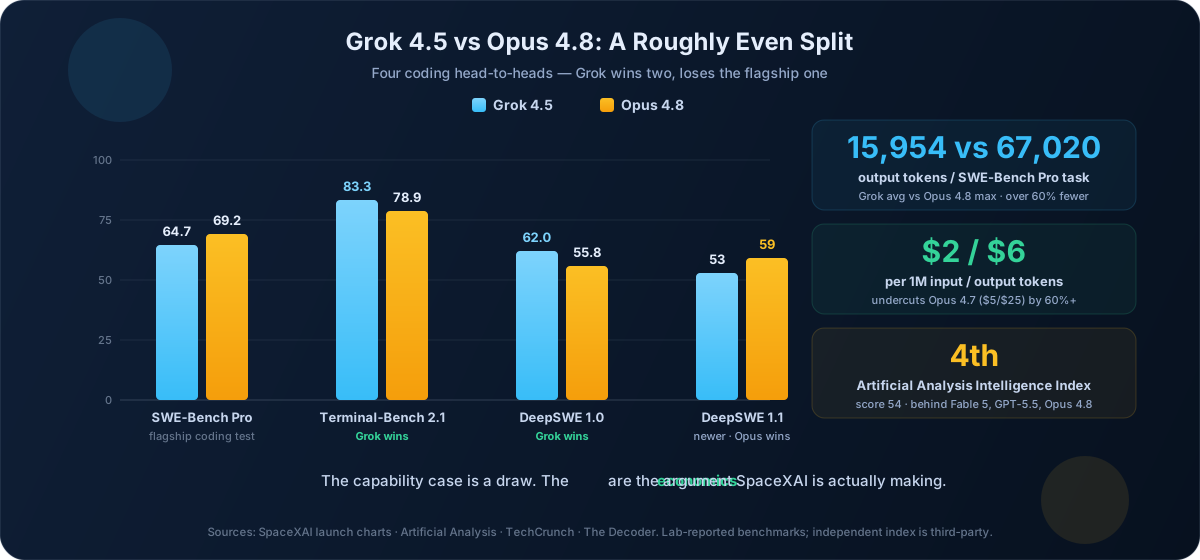
| Benchmark | Grok 4.5 | Opus 4.8 |
|---|---|---|
| SWE-Bench Pro | 64.7% | 69.2% |
| Terminal-Bench 2.1 | 83.3% | 78.9% |
| DeepSWE 1.0 | 62.0% | 55.75% |
| DeepSWE 1.1 | ~53% | ~59% |
| Avg output tokens / SWE-Bench Pro task | 15,954 | 67,020 (max) |
SWE-Bench Pro is the flagship coding benchmark, and Grok 4.5 loses it to Opus 4.8 by four and a half points. It wins Terminal-Bench 2.1 and DeepSWE 1.0, then loses the newer DeepSWE 1.1. That is a roughly even split across four head-to-heads. As one independent analyst put it, “Opus-class is a defensible label for a model that splits four head-to-heads roughly evenly. It’s not the same claim as ‘beats Opus.’” The “beats Opus 4.8 and GPT-5.5 on some benchmarks” headlines circulating this week are cherry-picked from that split, and most of them omit the benchmark SpaceXAI’s own users will care about most.
On the broad third-party measure — the Artificial Analysis Intelligence Index — Grok 4.5 scores 54 and ranks fourth, behind Fable 5, GPT-5.5, and Opus 4.8. That is a 16-point jump over Grok 4.3, a real generational gain, and still fourth place. Musk’s walk-back to “comparable to Opus 4.7” is the accurate framing: this model matches a prior-generation Anthropic release, not the current one. For context on where the bar sits, Opus 4.7 was itself only a narrow retaking of the frontier lead back in April, and the field has moved twice since.
The token-efficiency figure deserves the same scrutiny. The 4.2x claim compares Grok 4.5’s average output of 15,954 tokens per SWE-Bench Pro task against Opus 4.8’s maximum of 67,020. Average versus maximum is not a like-for-like comparison. Artificial Analysis’s more conservative phrasing — over 60% fewer output tokens — is the number to quote. It is still a large, real efficiency advantage. It is just not 4.2x.
The Economics Are the Real Story
Grok 4.5 is priced at $2 per million input tokens and $6 per million output. Anthropic’s Opus 4.7 runs $5/$25; GPT-5.5-class output pricing sits near $30 per million. That is an undercut of well over 60% against the models Grok is being compared to, and the token efficiency compounds it — fewer tokens per task multiplied by a lower price per token.
The clearest evidence sits in agentic coding, where Artificial Analysis runs each model inside its native harness. Grok 4.5 in Grok Build scores 76 on the AA Coding Agent Index — on par with GPT-5.5 in Codex, just below Fable 5 in Claude Code. The cost gap is where it stops being close:
| Agent (harness) | Coding Agent Index | Cost / task | Tokens / task |
|---|---|---|---|
| Grok 4.5 (Grok Build) | 76 | $2.49 | 1.9M |
| GPT-5.5 (Codex) | ~76 | $5.07 | 6.2M |
| Fable 5 (Claude Code) | top | $11.80 | 7.2M |
Grok 4.5 delivers roughly GPT-5.5-level agentic coding at half the cost and a third of the tokens, and lands within striking distance of the frontier Fable 5 at a fifth of the price. For teams running coding agents at volume — where token spend is the line item that actually scales — that arithmetic matters more than four points on SWE-Bench Pro. The Decoder’s read, that the price gap may make the benchmark gaps irrelevant, is a fair summary of the launch.
The Caveat the Efficiency Story Buries
There is a reliability regression that the token-and-price narrative conveniently skips. On Artificial Analysis’s knowledge measures, Grok 4.5’s AA-Omniscience Index rose to 26 from 18, and accuracy climbed to 52% from 35% — genuine improvement. But its hallucination rate rose to 54%, up from 25% on Grok 4.3. The model knows more and makes things up more than twice as often. For agentic coding, where a confident wrong answer gets committed to a branch, that doubling should govern how much autonomy you hand this model before a human reviews the diff.
Not all of these figures carry equal weight. The SWE-Bench Pro, Terminal-Bench, and DeepSWE numbers originate largely from SpaceXAI’s own charts; only the Artificial Analysis Intelligence and Coding Agent Index results are fully third-party. SpaceXAI’s launch page returned errors to automated retrieval, so the lab’s own figures here are corroborated through independent coverage rather than read off the source. Lab benchmarks and aggregator tables routinely disagree, and this launch is no exception.
What To Watch
This is SpaceXAI’s first coding-specific model, arriving days after the lab rebranded from xAI and folded into SpaceX’s orbit, and it lands as an economics play rather than a capability leader. That is a coherent position. The most valuable spot in a commoditizing market is often not the frontier — held here by Fable 5 and a still-formidable Claude Sonnet 5 on the agentic side — but the point on the cost-capability curve where “good enough, far cheaper” wins the volume buyer. Grok 4.5 is aimed squarely at that point, and the jump from Grok 4.3 shows the lab can move quickly.
Two things will decide whether the position holds. The first is whether the Cursor-trained data advantage shows up in production work, not just benchmarks — real codebases are messier than session traces, and the hallucination rate is a warning sign. The second is whether Anthropic and OpenAI respond on price. SpaceXAI’s entire pitch rests on a 60%-plus discount; if the incumbents cut, the argument thins fast. For teams evaluating Grok 4.5 now, the sensible move is to pilot it on a bounded, reviewable workflow, measure token spend against your current model, and treat the “Opus-class” label as marketing until your own numbers say otherwise.